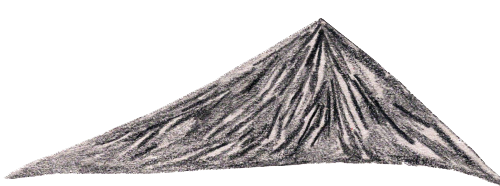

- Life Beyond… I-VI., 2024-2025
- They Are Not Quiet, Quiet, Like The Little Emptinesses I Carry, 2025
- There Is A Snake In Swans, 2025
- I Am The Center Of An Atrocity, 2025
As part of the 2025 Off Biennale, this series of mine focus on women in the final years of their fertility, who are considering the possibility of having children. While emotionally and physically prepared, the global crises of our time – climate change, social, economic, and epistemological collapse – confront them with ethical uncertainty. What constitutes responsible action? To bring a child into a world defined by ongoing, large-scale crises, or to refrain – and perhaps seek fulfillment through alternative forms of connection with the Other and with nature?
One recurring figure in the drawings – a woman standing at the mouth of a cave, her back turned – marks the artist’s position at the intersection of ethics and identity. She appears at a threshold between ending and beginning, symbolizing a transitional stage in self-understanding and a life phase: the final years of fertility. This back-turned female figure also evokes an art historical archetype, as seen in classical paintings such as Titian’s Venus of Urbino, where deeper tension resides not in the foreground odalisque, but in the subtle gestures of the background figures.
I define my creative stance in a similar manner: “Driven by an inner compulsion, I turn away from conventional female roles to search through personal and inherited containers – trousseaus, linen trunks, laundry boxes. Often working in physically uncomfortable, socially unflattering positions, I bring to light contents once thought forgotten, unwanted, or threatening.”
The triptych explores bodily visions of childbirth, emphasizing the double vulnerability of the female body. It contrasts the instinctive, self-regulating processes of labor with the mechanized, often impersonal protocols of obstetric care. While both forces can overpower the individual, the former may unfold as a deeply affirming experience, whereas the latter – through dehumanization – frequently becomes a site of trauma.
The titles of the paintings are quotations from Three Women, a poem by Sylvia Plath. The poem presents the experience of childbirth through the voices of three women – one who gives birth, one who miscarries, and one who gives her child away – exploring the complex emotional and social dimensions of motherhood, the female body, and loss.
Sylvia Plath
Three Women
A Poem for Three Voices (detail)
Setting: A Maternity Ward and round about
“(…)
FIRST VOICE:
A power is growing on me, an old tenacity.
I am breaking apart like the world. There is this blackness,
This ram of blackness. I fold my hands on a mountain.
The air is thick. It is thick with this working.
I am used. I am drummed into use.
My eyes are squeezed by this blackness.
I see nothing.
(…)
SECOND VOICE:
It is a world of snow now. I am not at home.
How white these sheets are. The faces have no features.
They are bald and impossible, like the faces of my children,
Those little sick ones that elude my arms.
Other children do not touch me: they are terrible.
They have too many colors, too much life. They are not quiet,
Quiet, like the little emptinesses I carry.
(…)
THIRD VOICE:
And the great swan, with its terrible look,
Coming at me, like a castle, from the top of the river.
There is a snake in swans.
He glided by; his eye had a black meaning.
I saw the world in it–small, mean and black,
Every little word hooked to every little word, and act to act.
A hot blue day had budded into something.”

Quiet, Like The Little Emptinesses I Carry

There Is A Snake In Swans

I Am The Center Of An Atrocity


