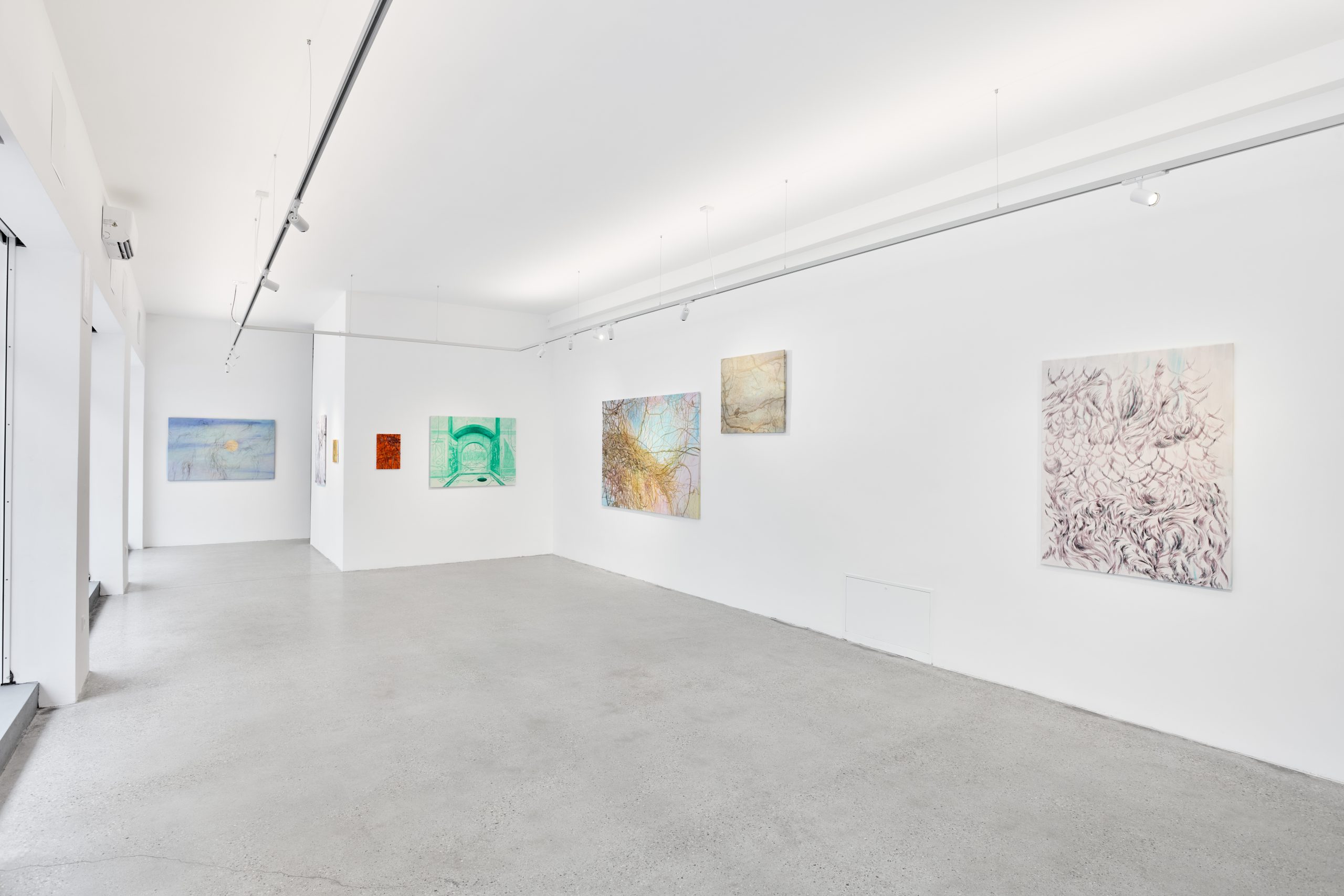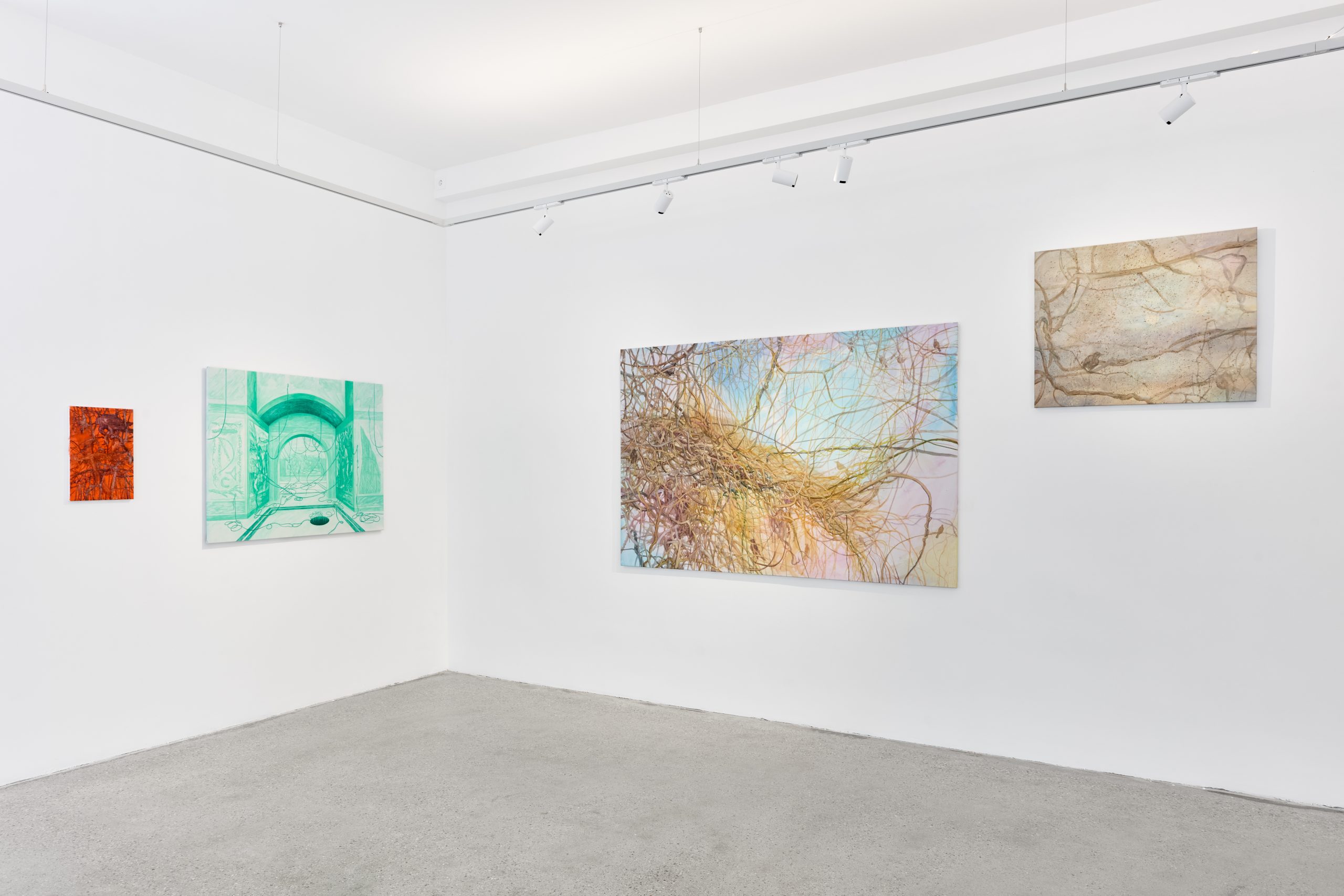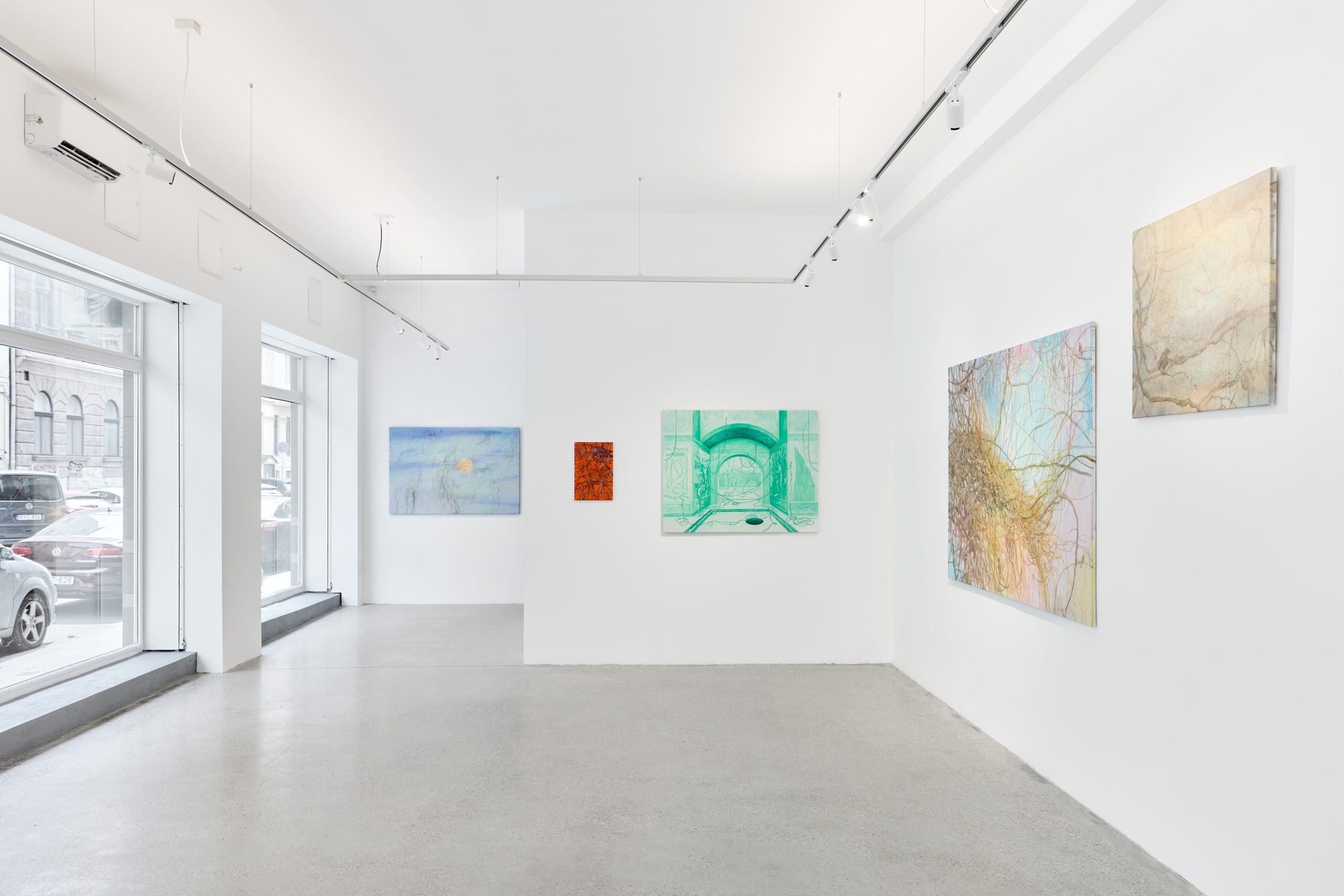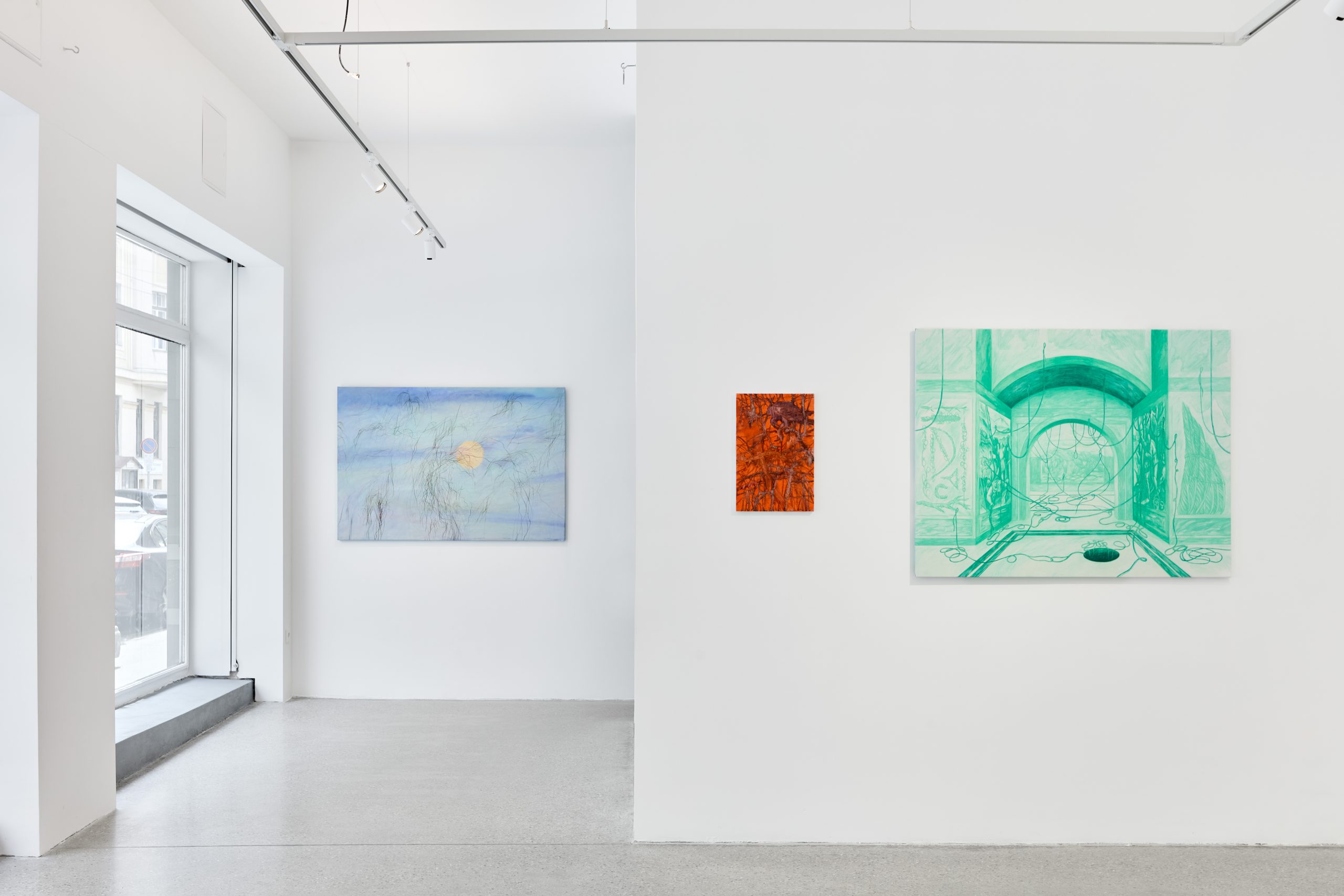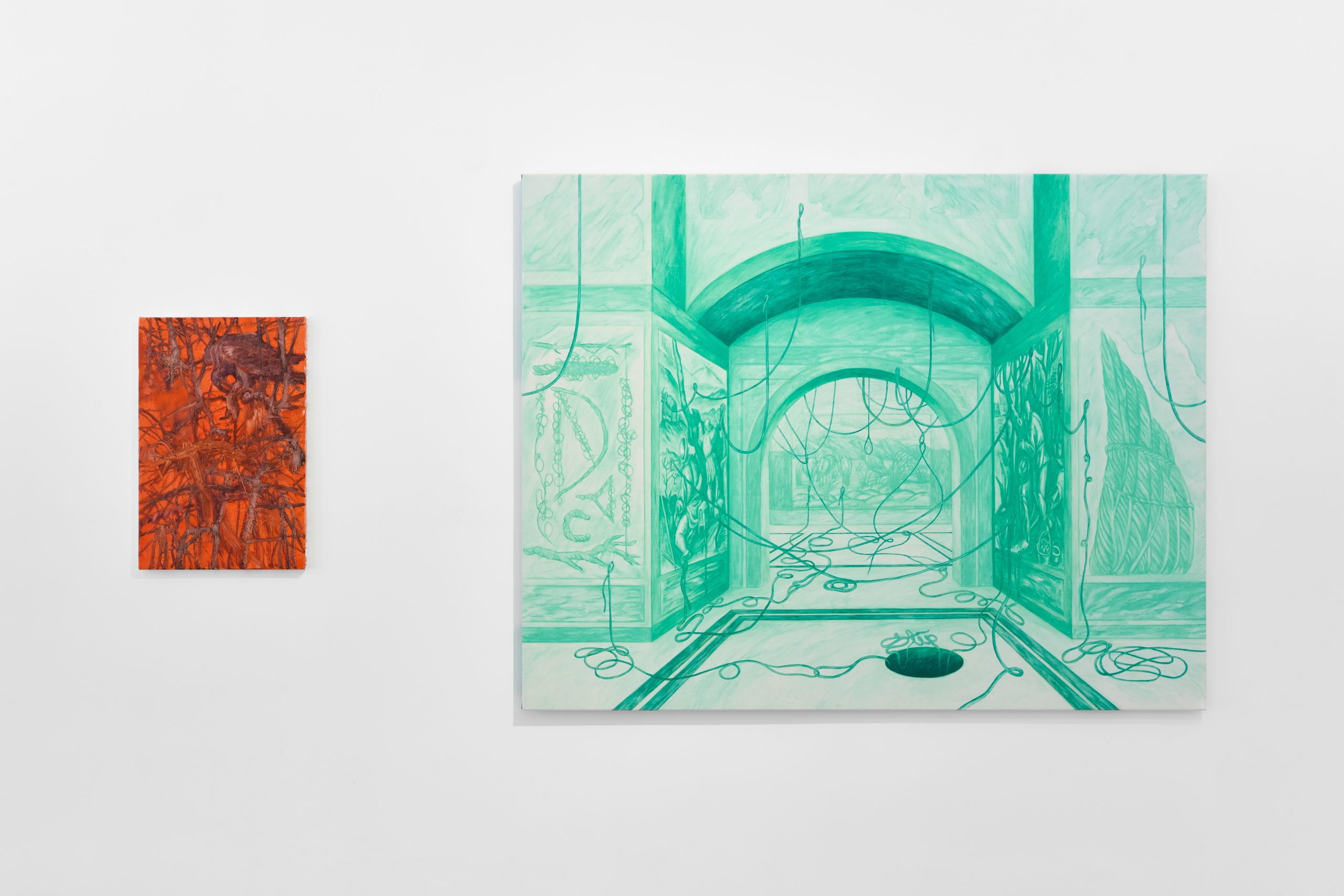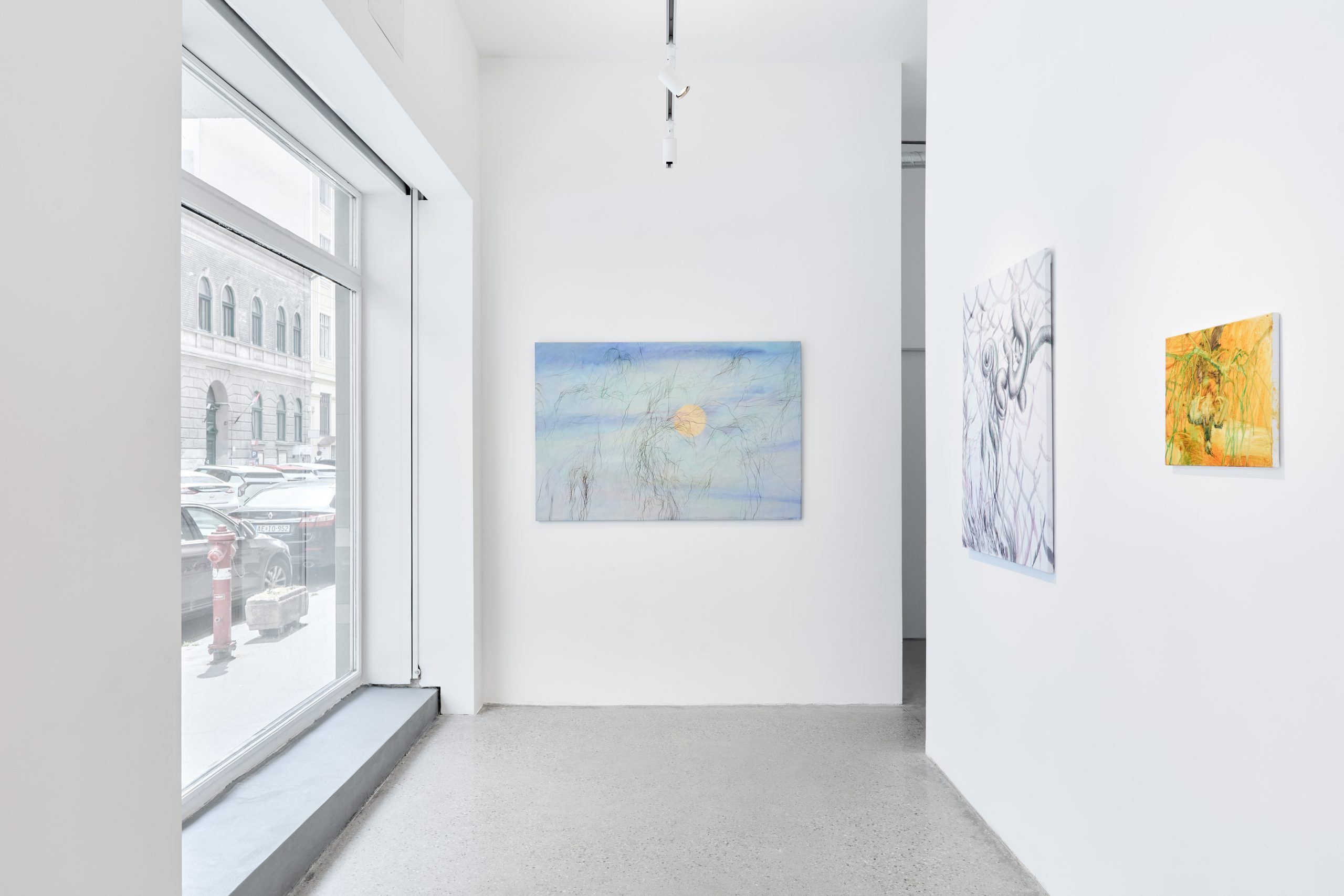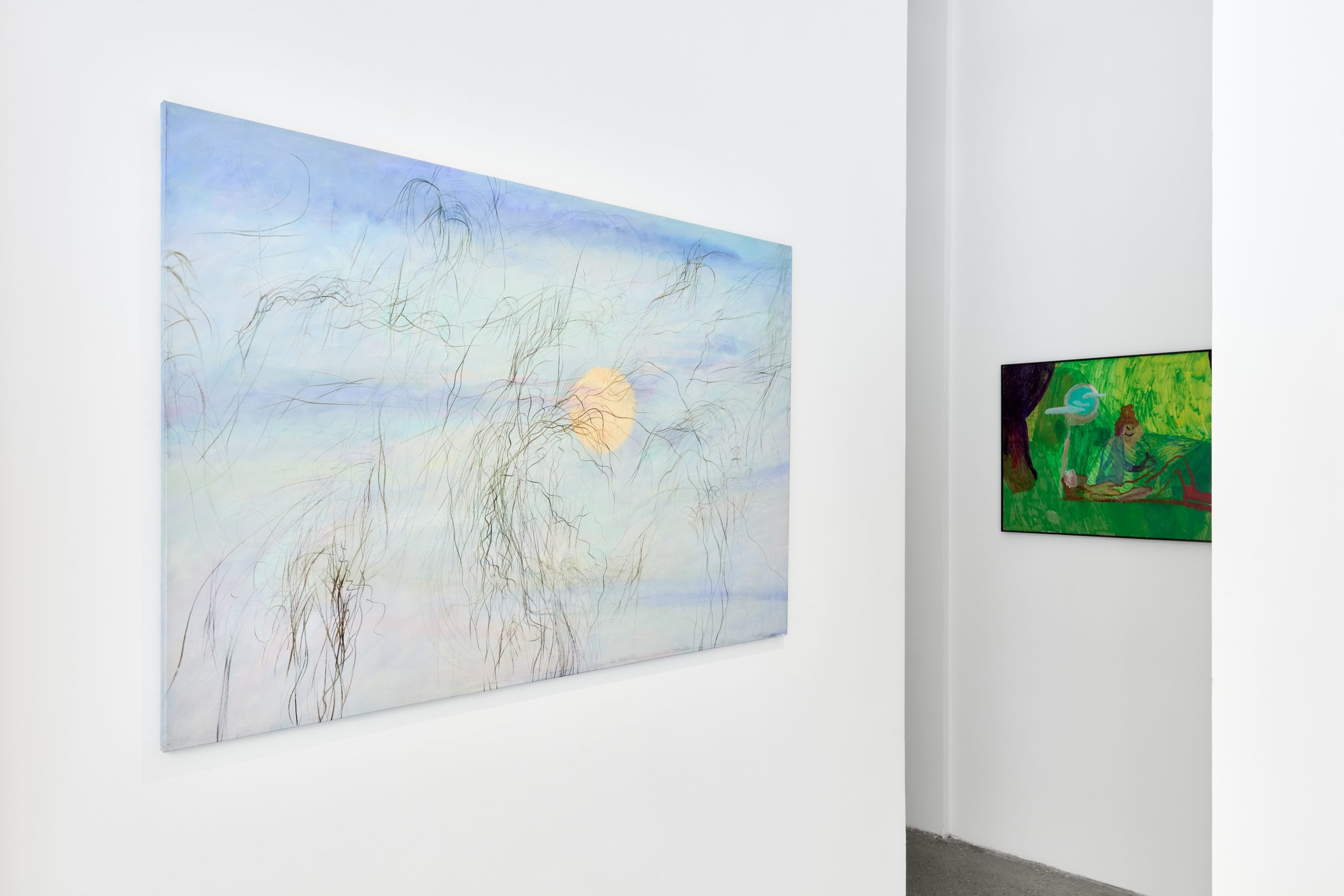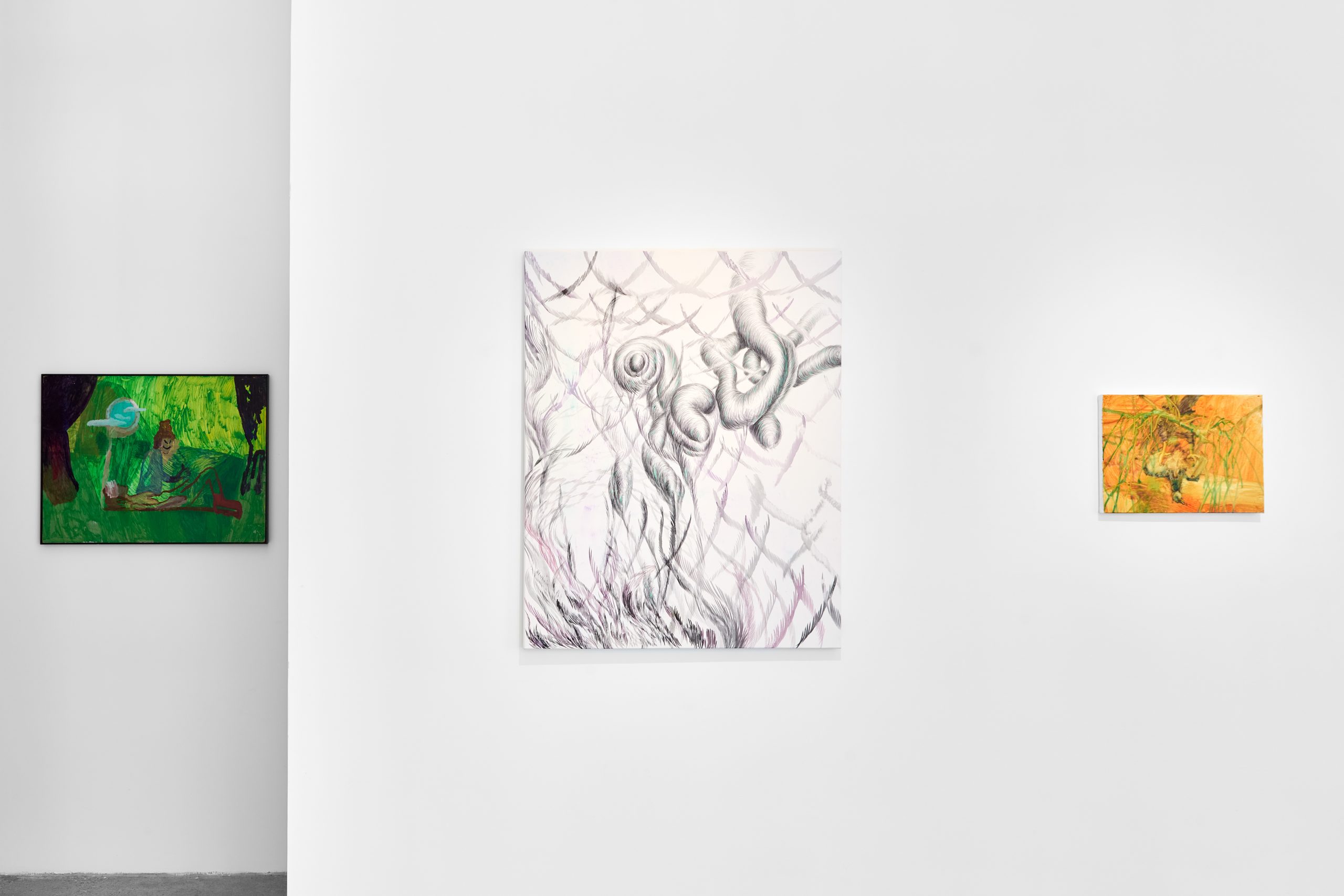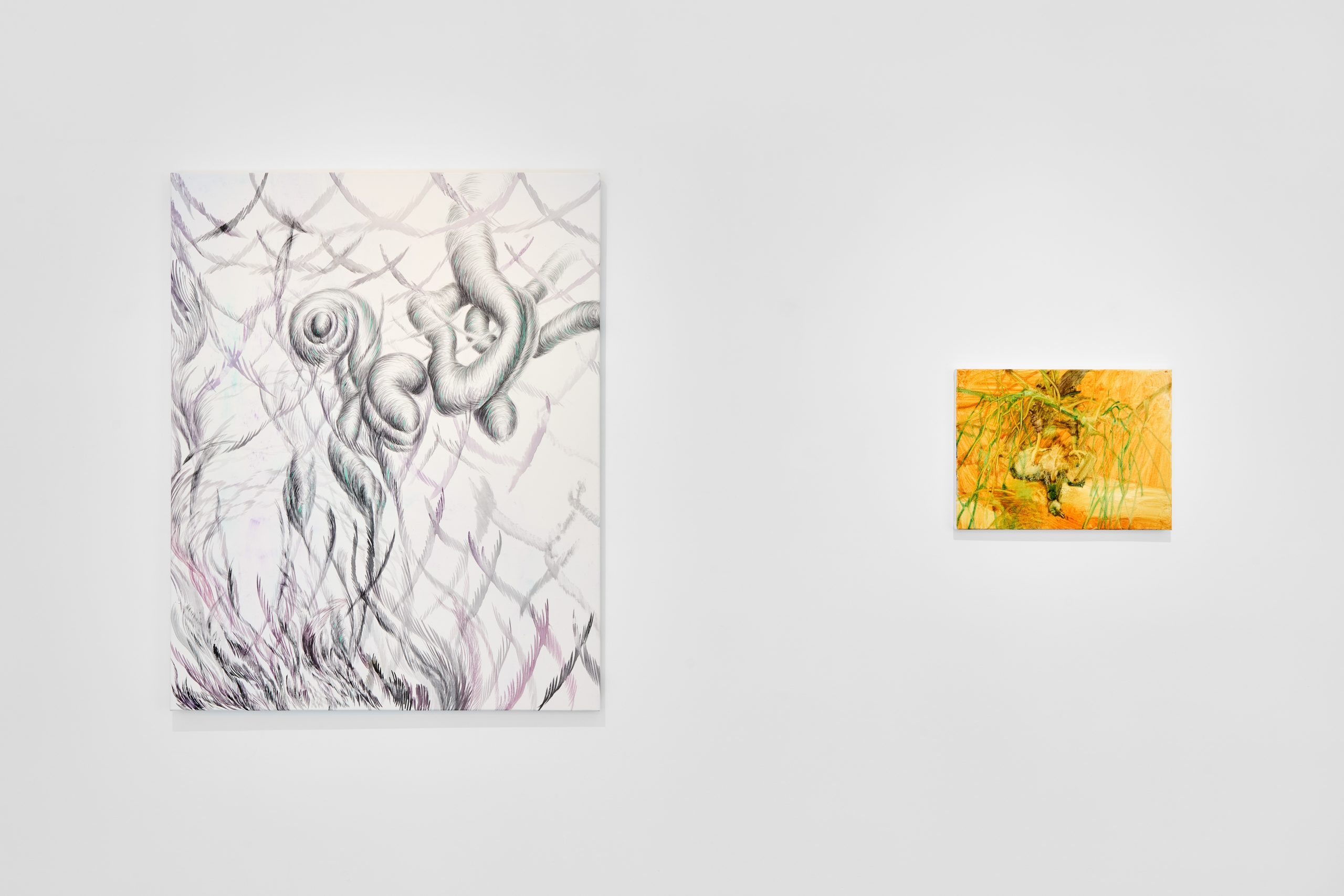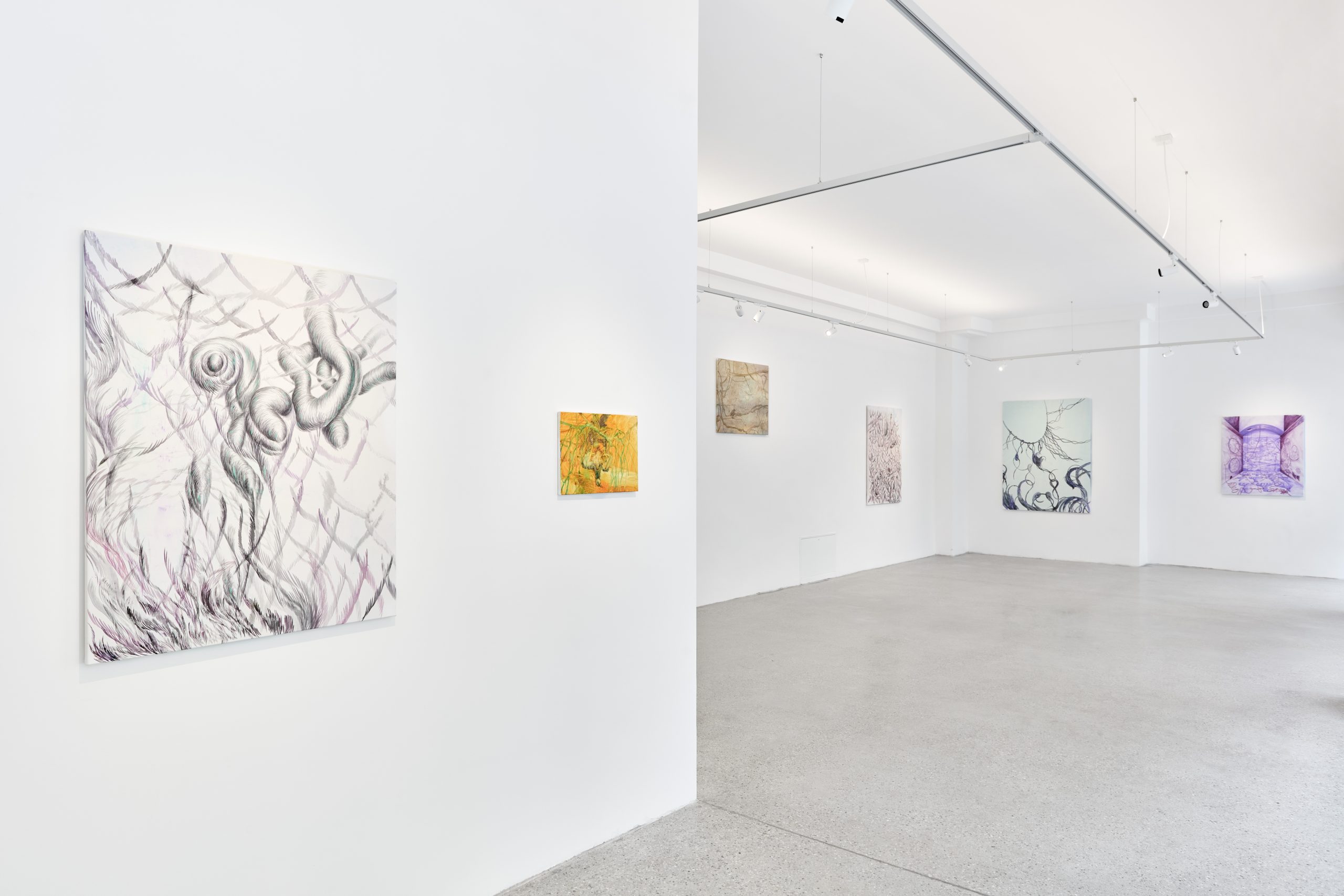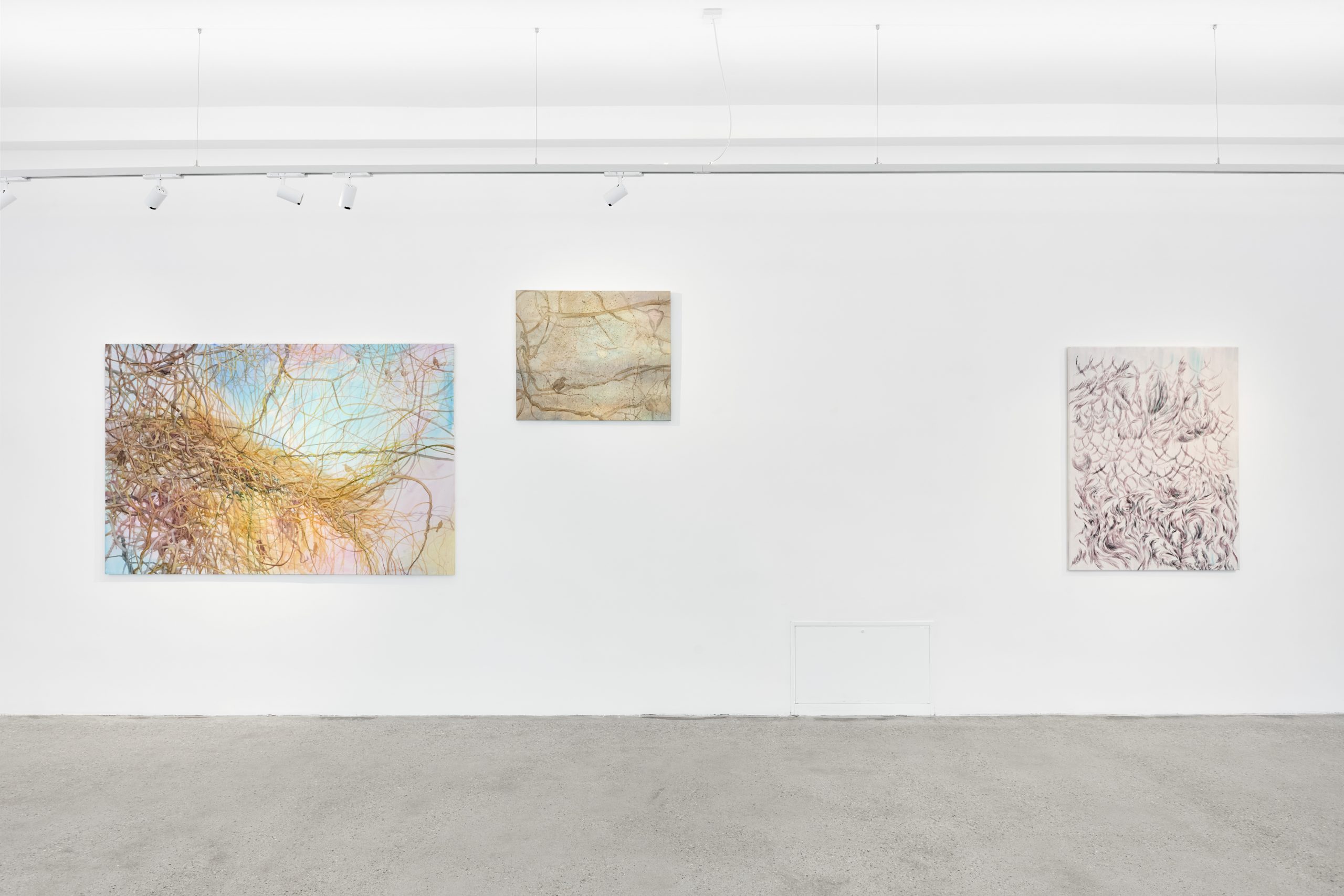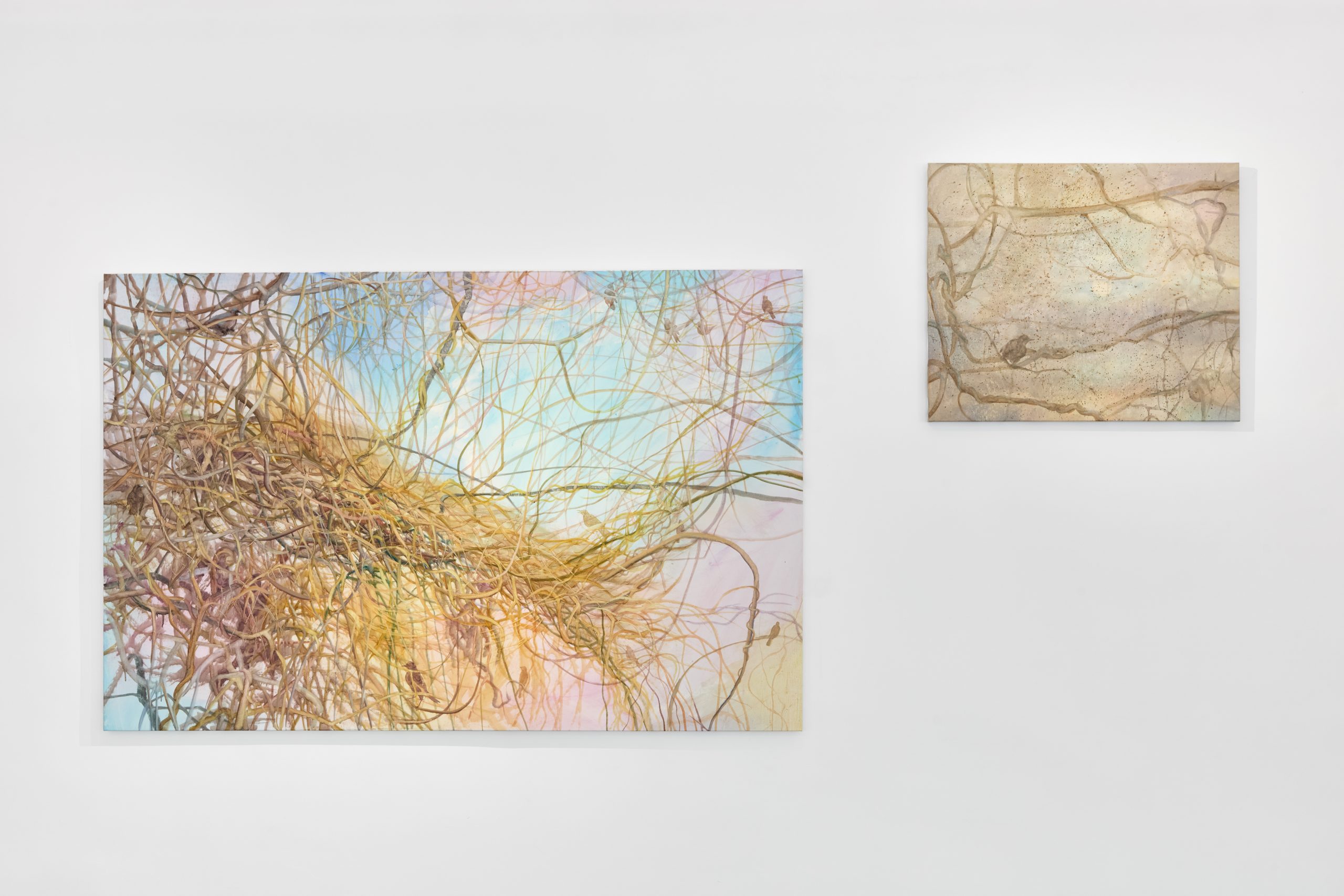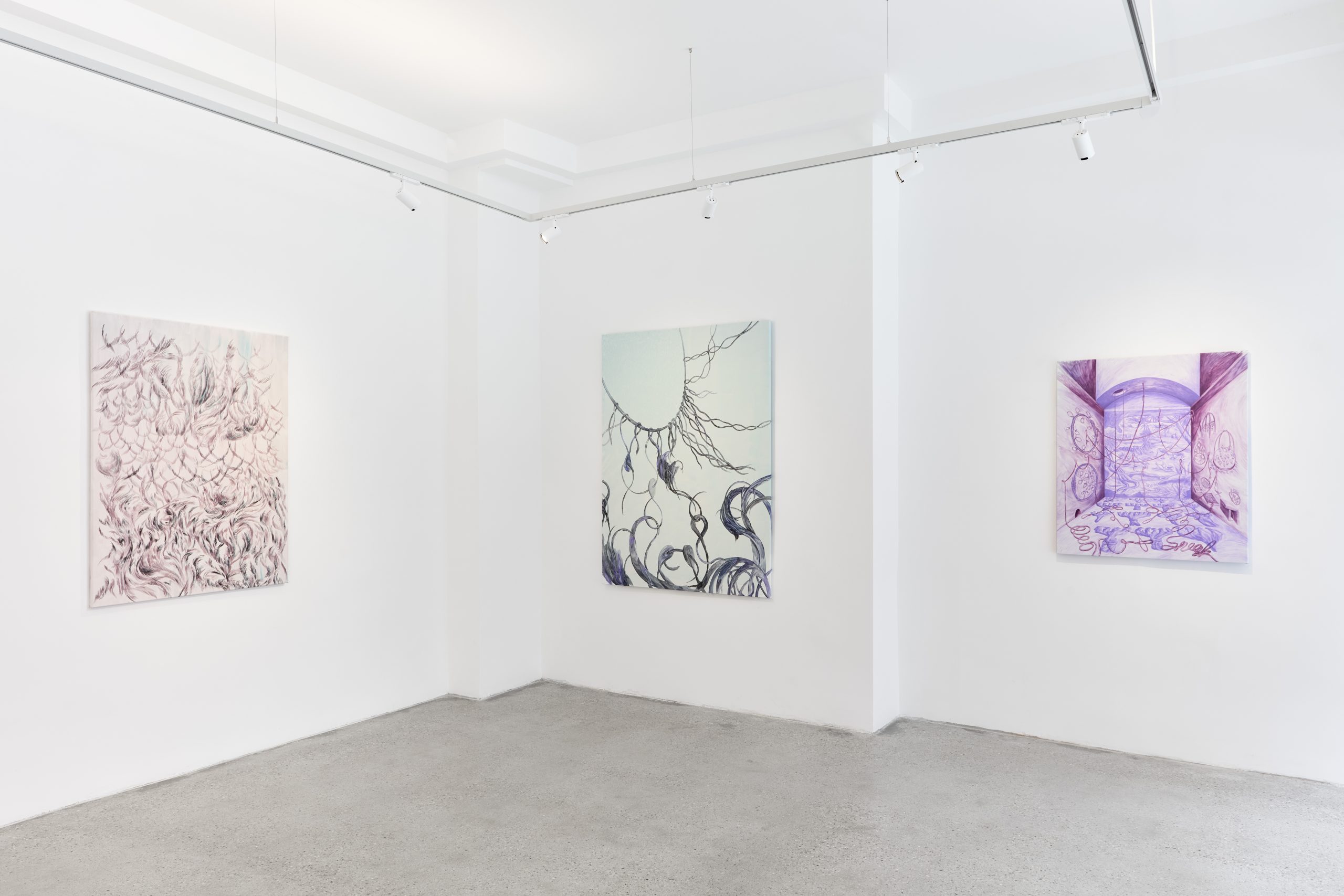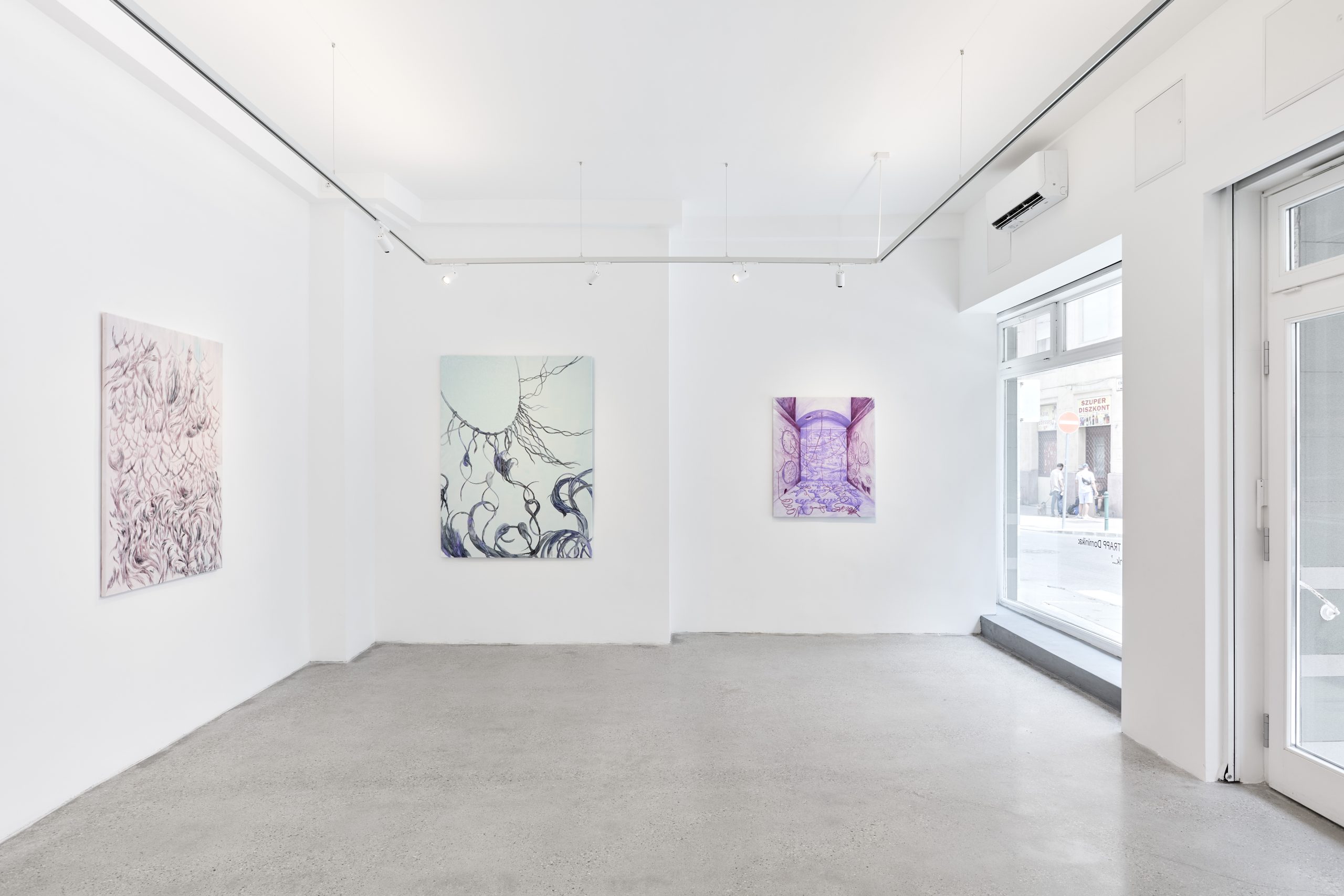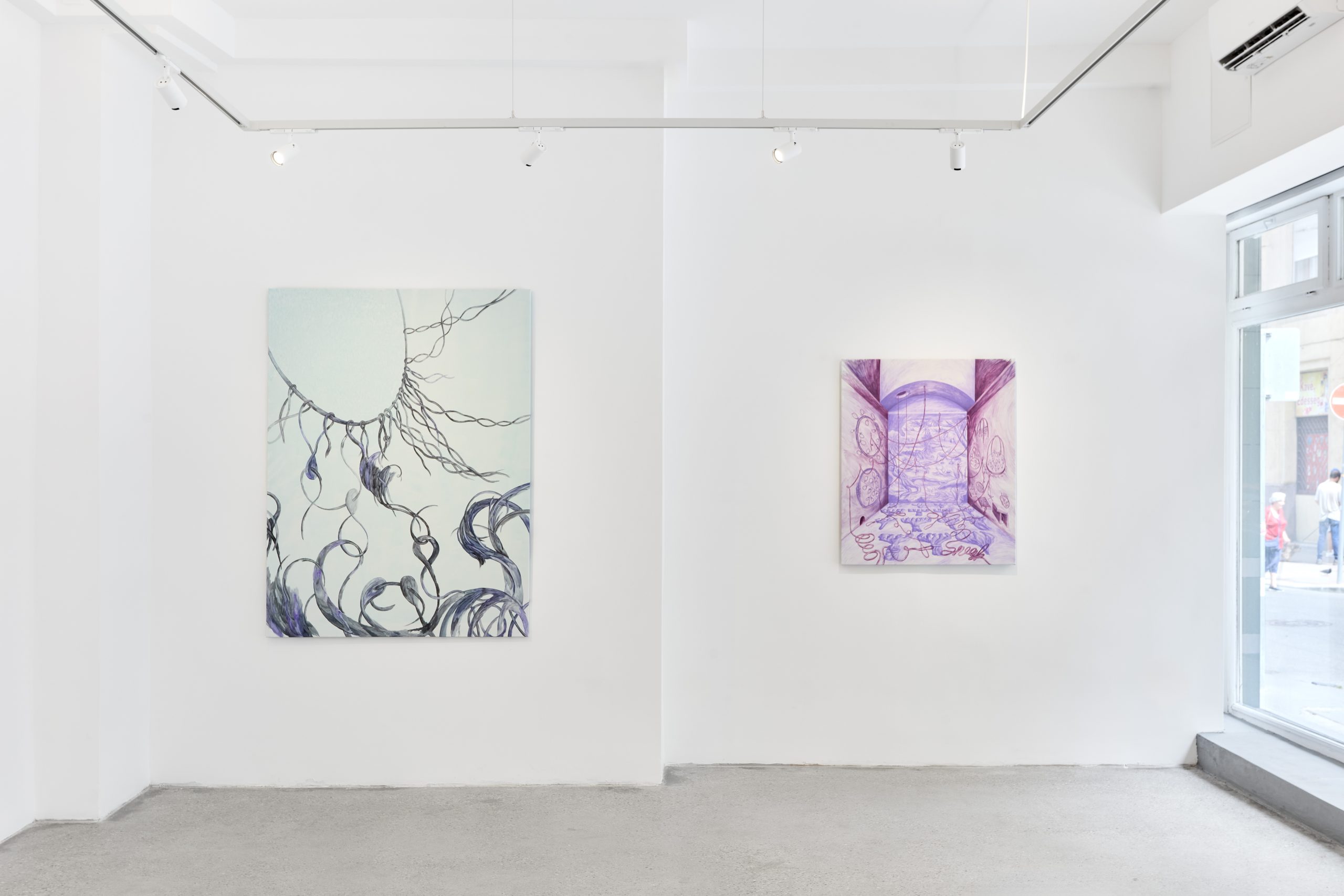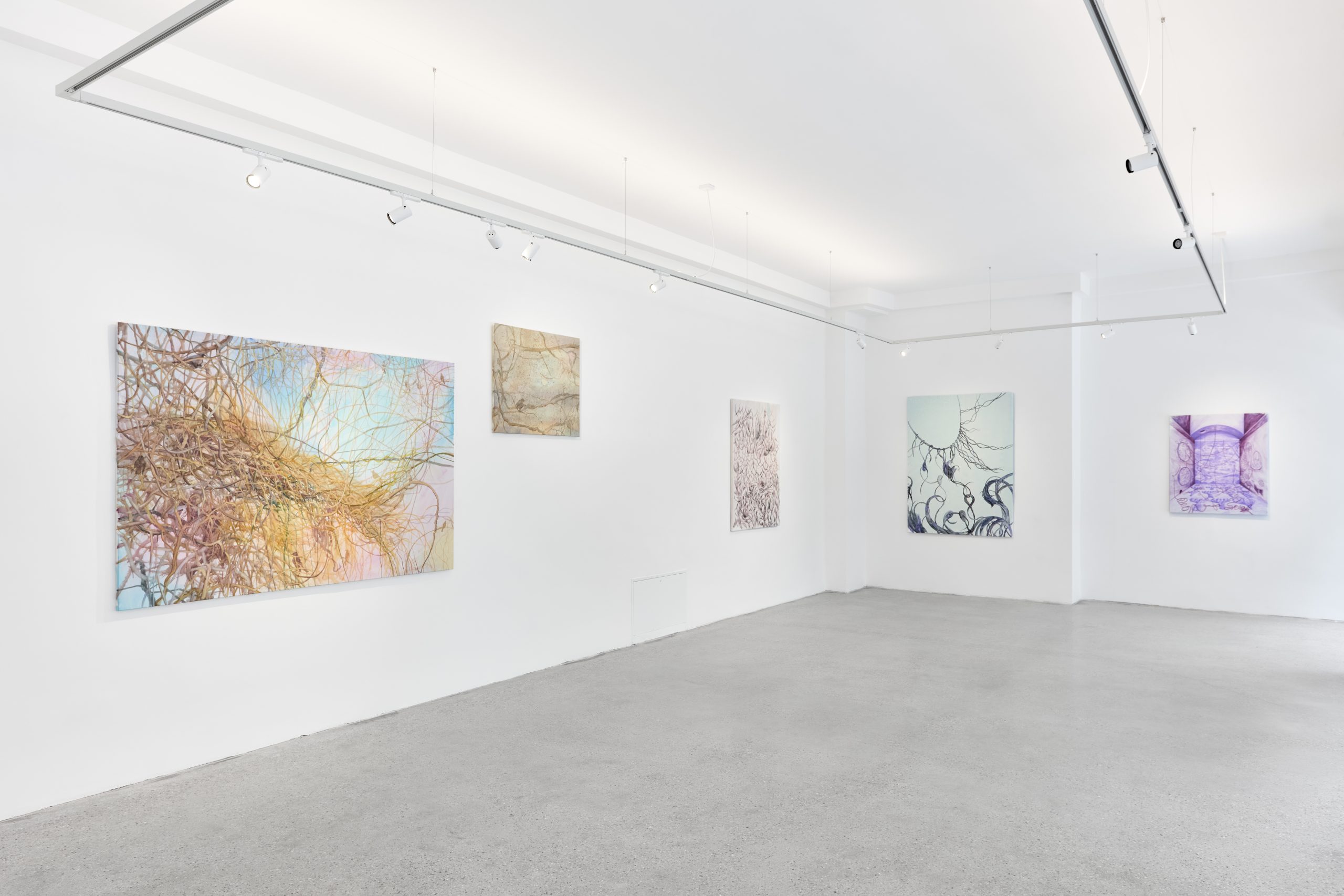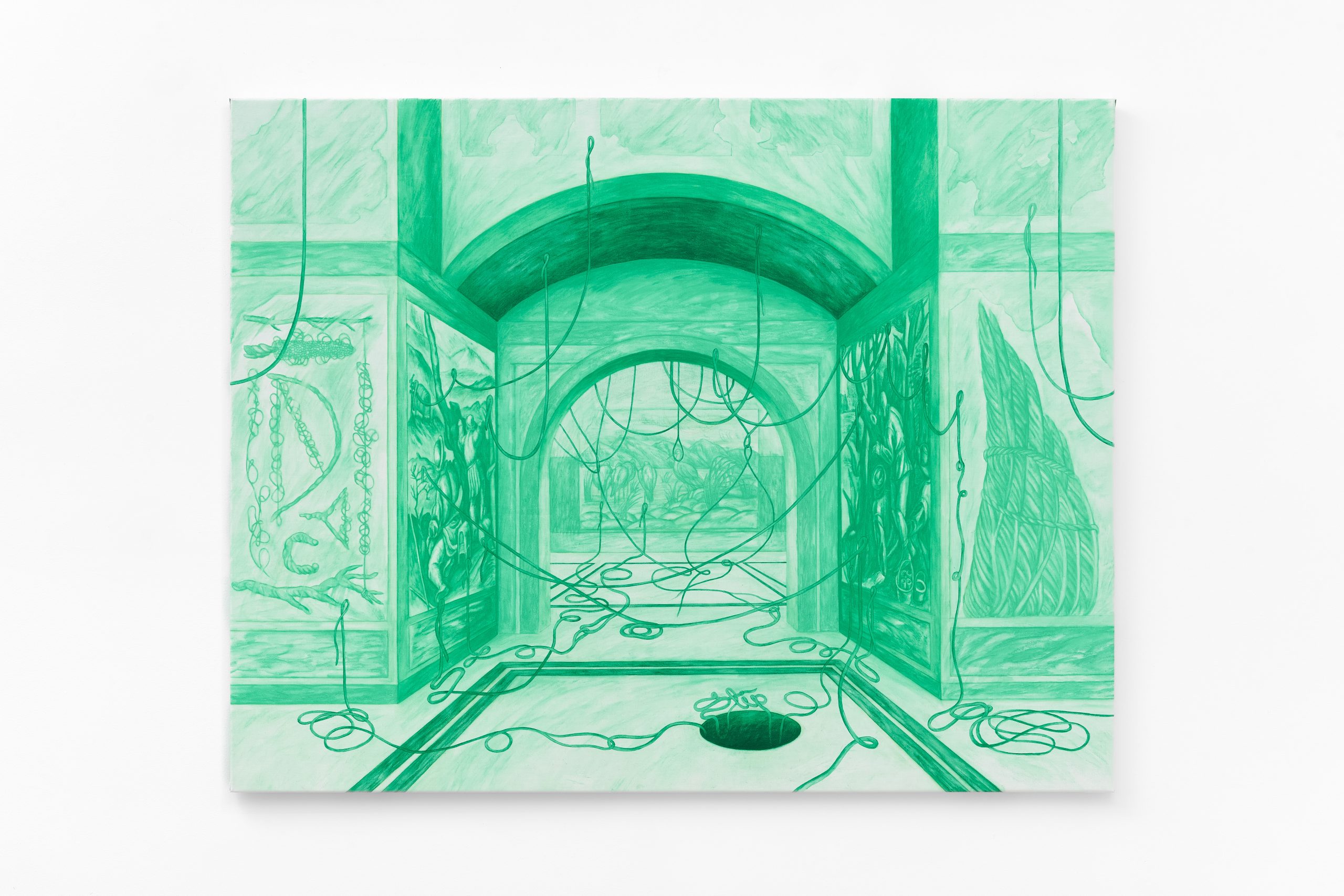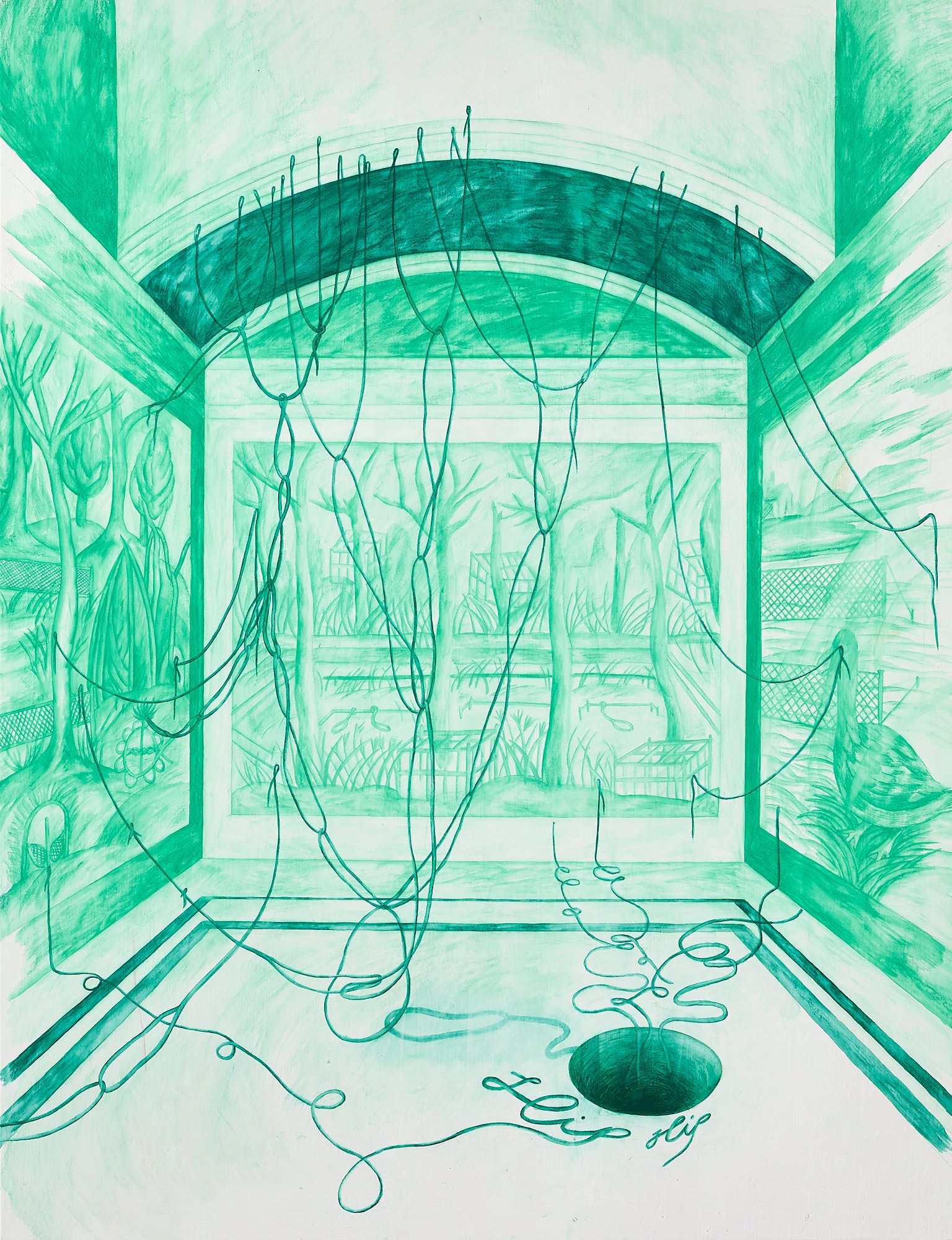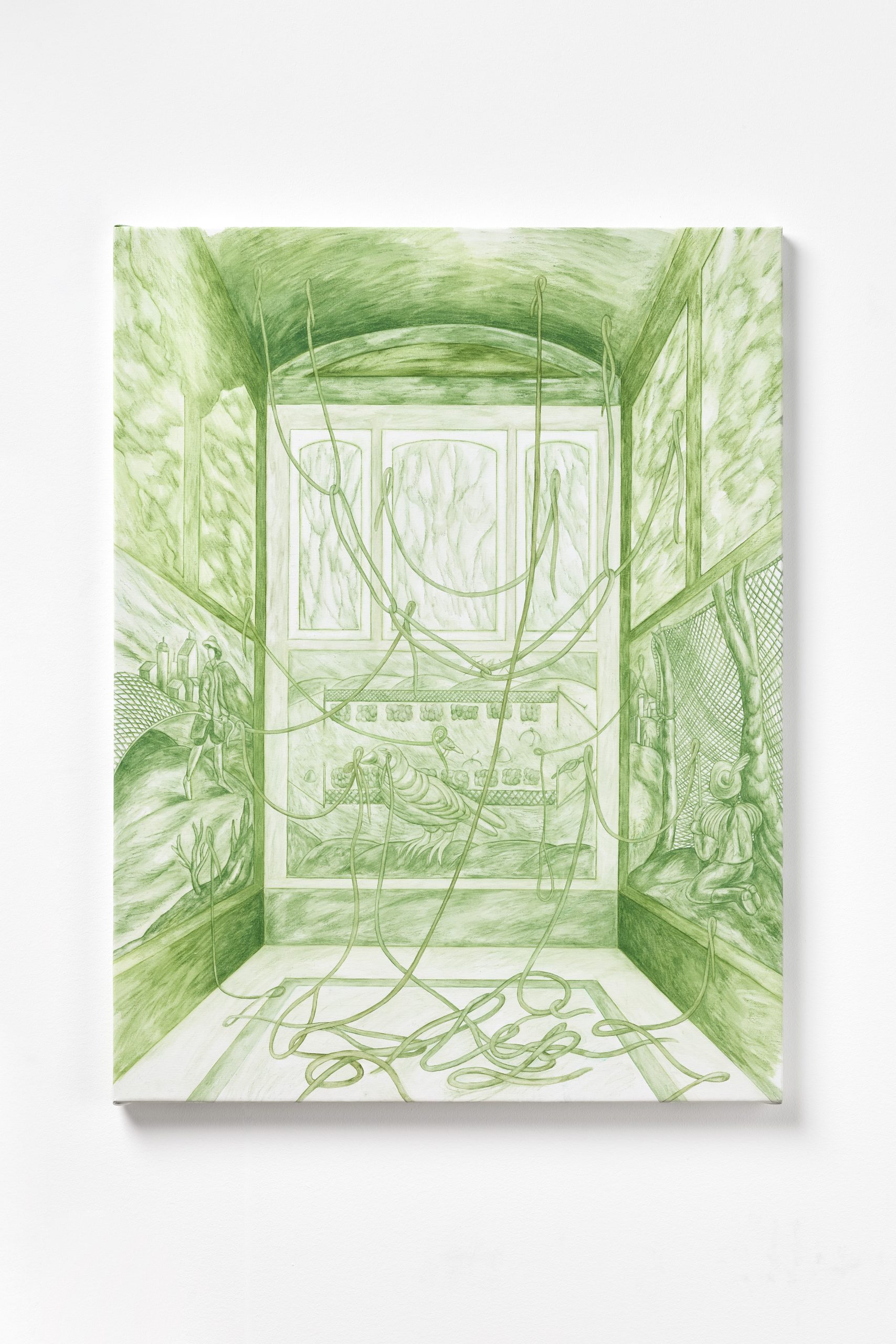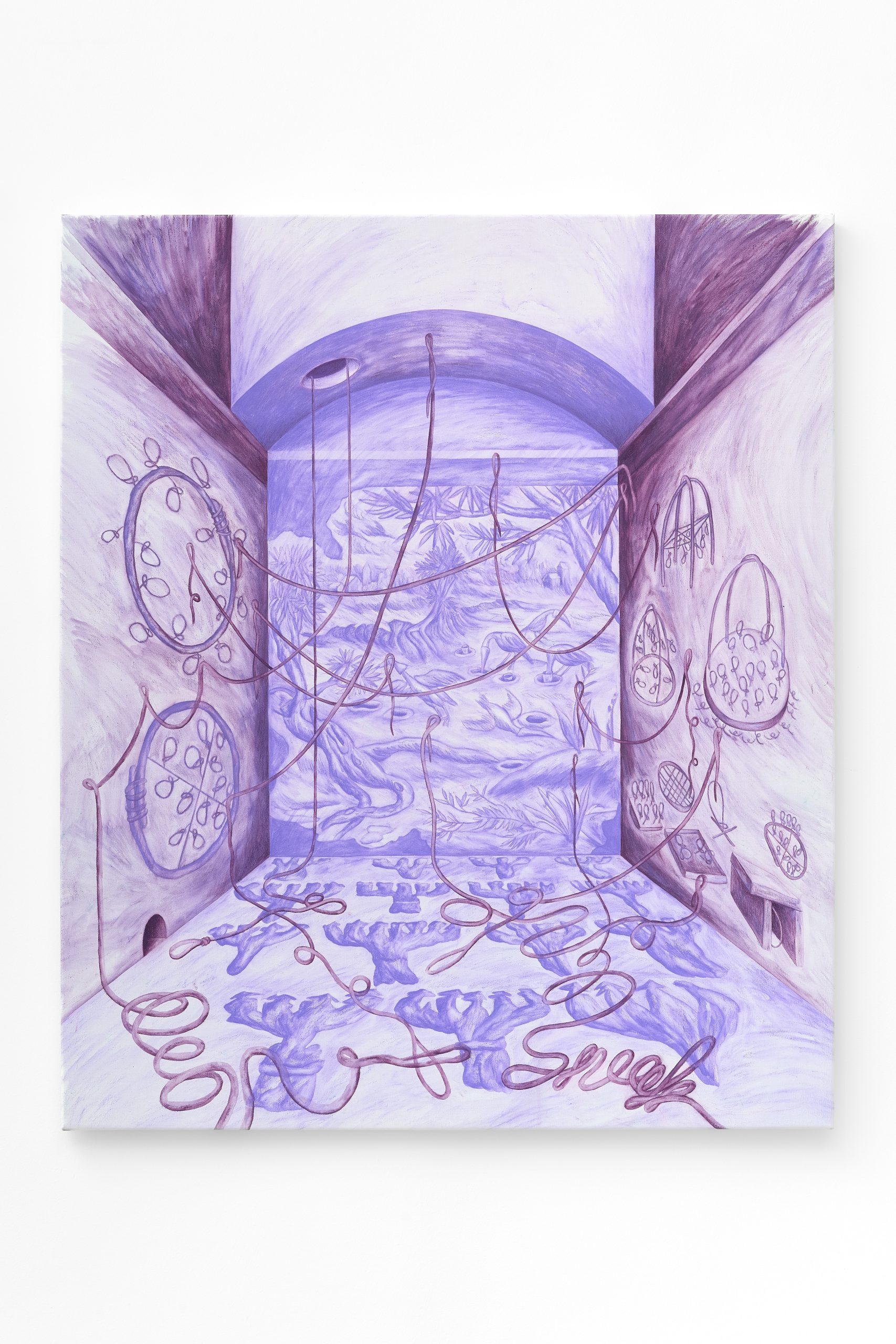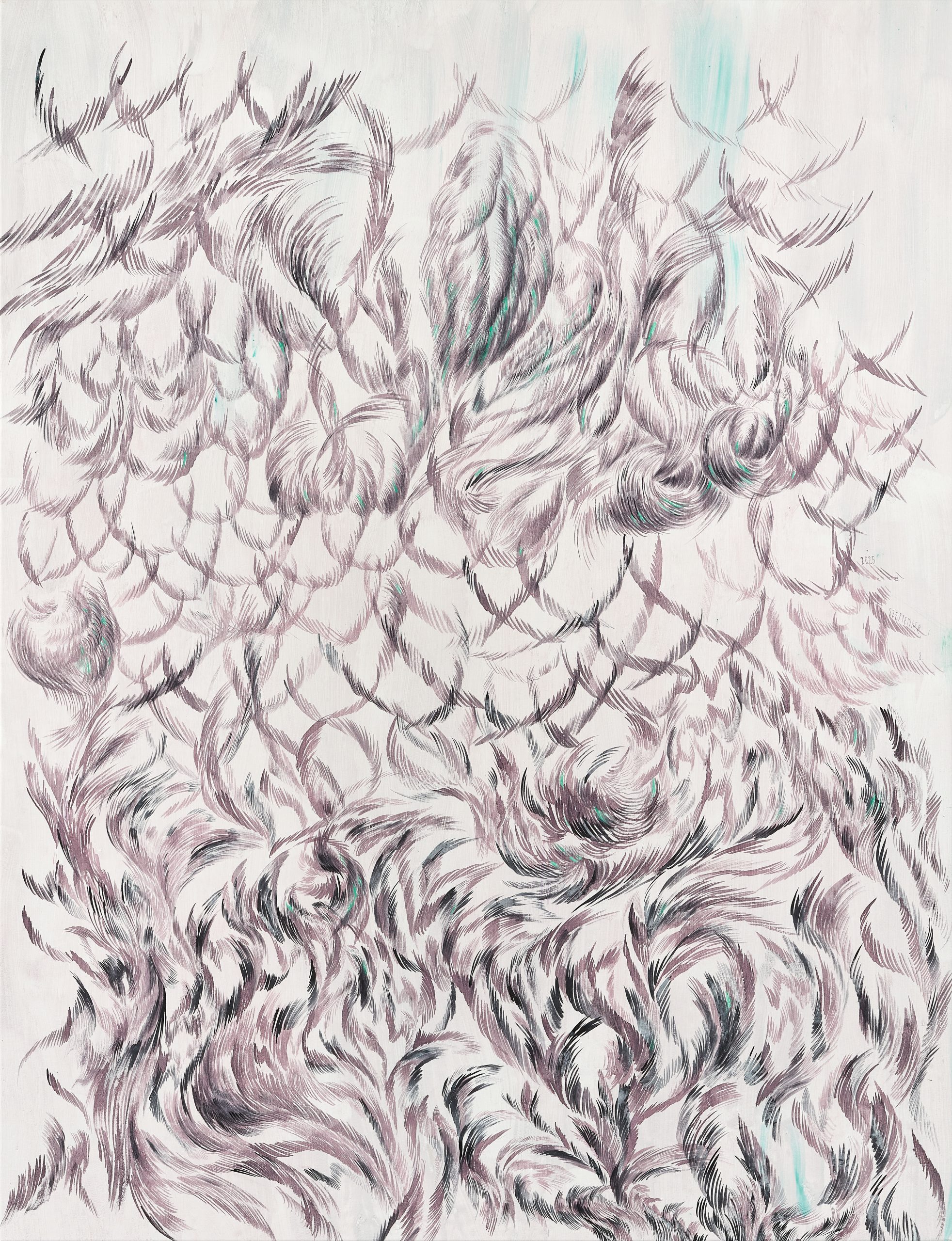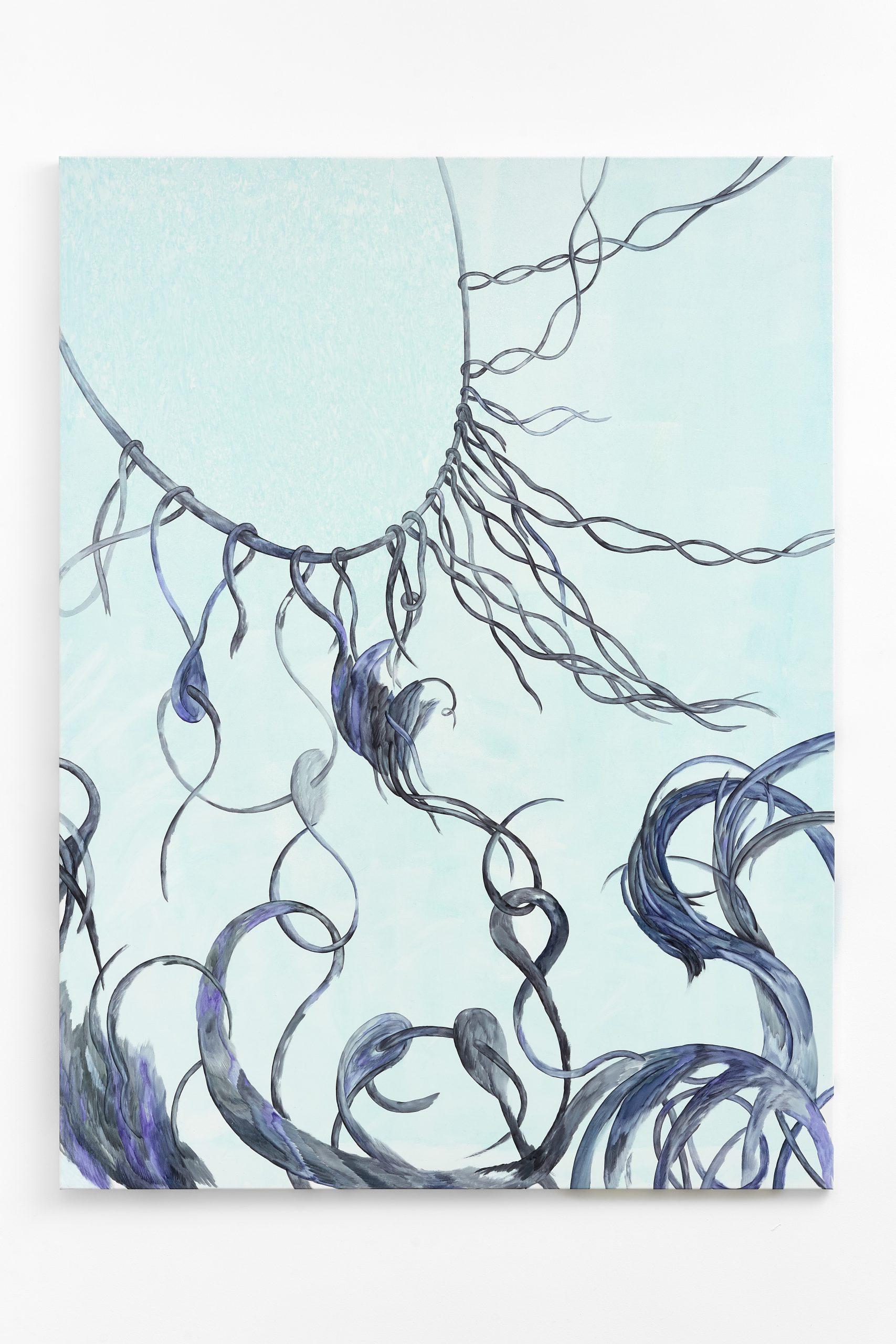
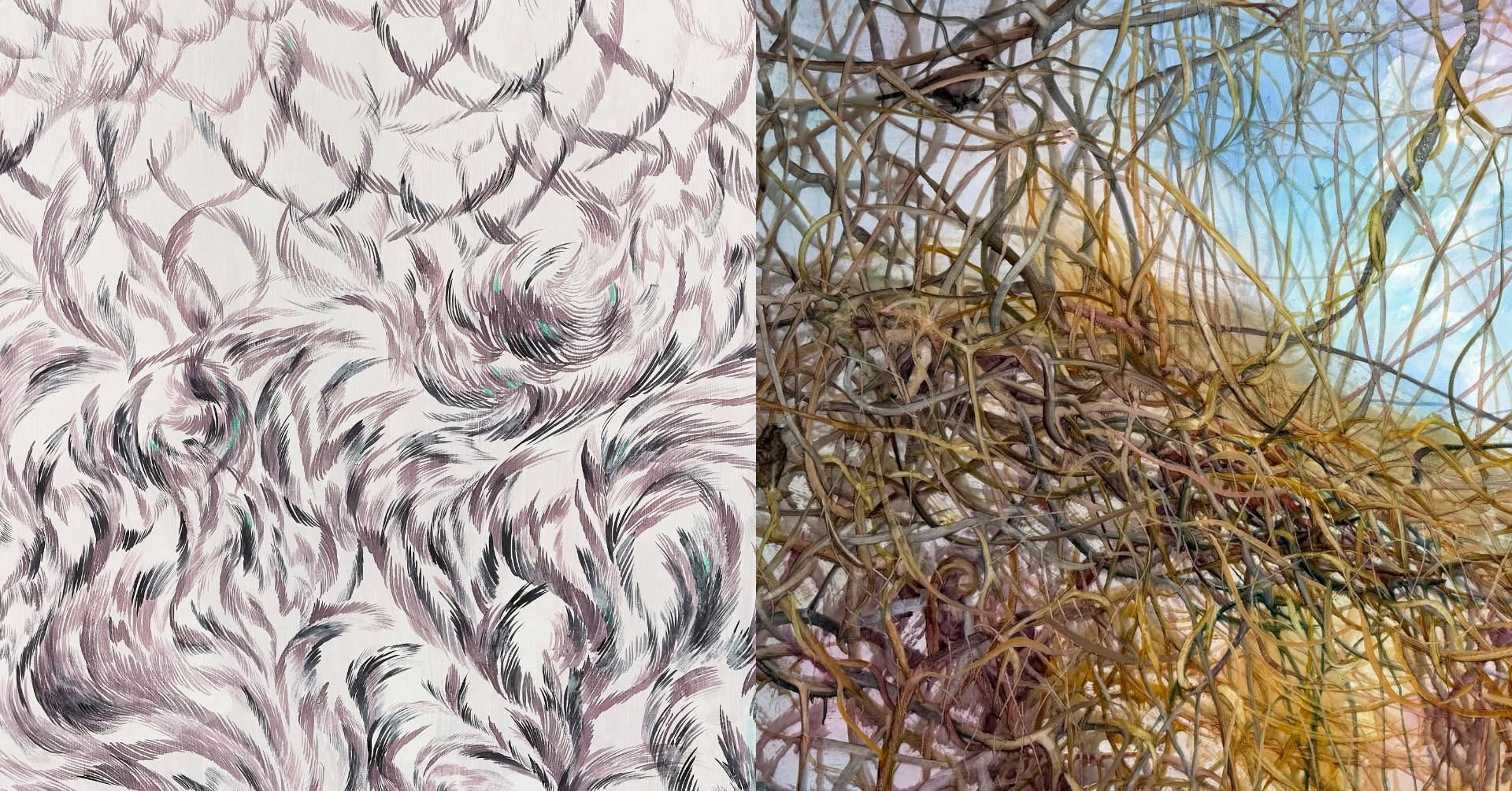
“In the paper-based works and paintings of Kateryna Aliinyk and Dominika Trapp, the close attention to landscape allows for a range of relationships to emerge, evoking profound sensory and spiritual experience. Trapp’s artificial terrains host fictive, dystopian scenes and serve as choreographed stages in which latent violence and entanglement unfolds through intricate detail. Aliinyk turns to another space-time—nature’s infinity and its persistent capacity for regeneration despite war and destruction. Amid conflicting feelings of fear, admiration, and alienation, a form of radical joy emerges.”
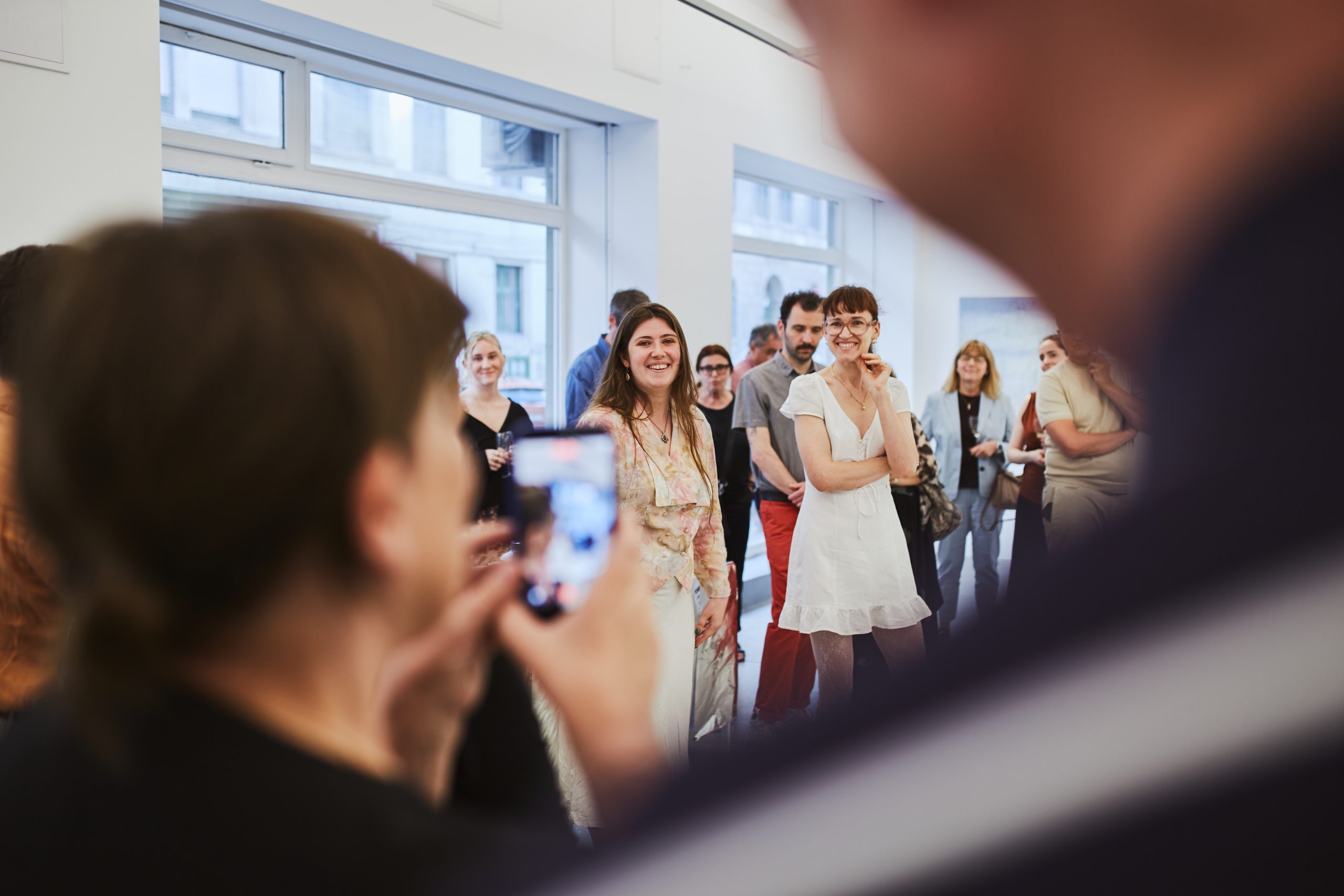
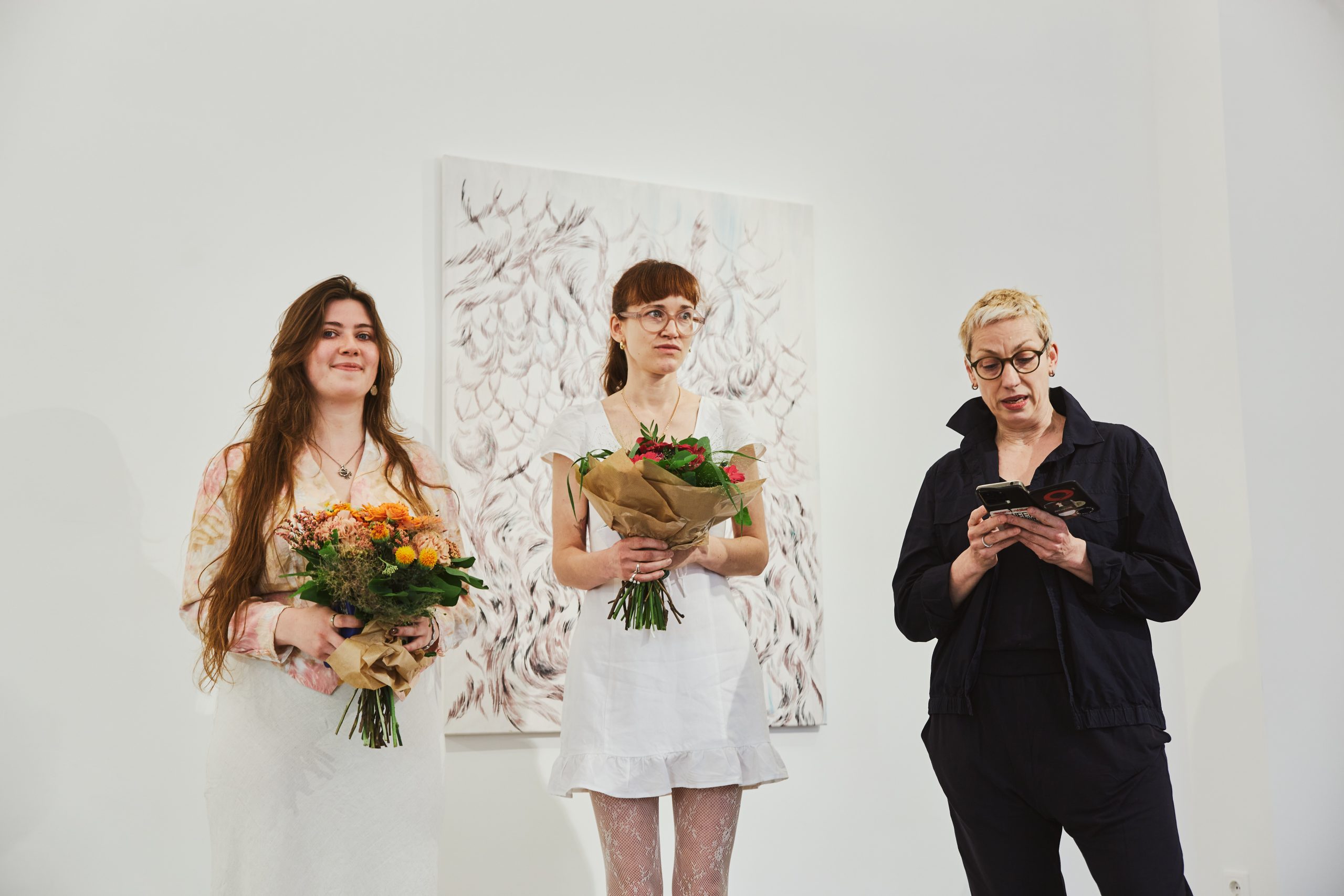
Our collaboration has a simple, but rather beautiful story. We have shown together in numerous group exhibitions across Europe, most recently in Białystok, Poland, in 2025. There, I walked up to Kateryna and introduced myself. We talked for hours and hours, and it quickly became clear how much common ground we shared – not only in the subjects we’re drawn to, visionary landscape as a shared point of departure, but also in our theoretical interests.Chief among these is the philosophy of Simone Weil, to whom we both seem to turn in times of crisis. It is from Weil that I have learned perhaps the most about attention. For her, attention is at once a spiritual and an ethical practice, manifest as much in the contemplation of nature’s beauty as in the capacity to be truly present for another’s suffering. Kateryna’s most recent exhibition – her first solo show in Kyiv, curated by Milena Komchenko – was partly shaped by Weil’s thought, and by the idea that attending to beauty in the midst of violence is not a form of withdrawal, but an ethical stance, perhaps even a form of courage.
I feel a particular thrill whenever I encounter an artwork that carries the very way of seeing that first led me to painting, twenty years ago. In Kateryna’s work, the primacy of intuition is unmistakable to me, and I believe that same organic sensibility guided our exhibition as it took shape. In my own work, perhaps the only conscious decision I made from the outset was to depict the landscape in mediated form. If the wounded landscape is also the landscape of war – as it is in Kateryna’s work – I cannot represent that experience directly, because it is not a reality I live in. For me, maintaining this distance is an ethical question. The trap scenes evolved according to a similarly simple principle: hunter and prey never appear in the same image. The paintings do not depict the moment of violence itself, but rather the conditions that make violence possible. What happens next is left unresolved.
This is also why I find it important, in relation to the exhibition, to speak about the ethics of representation and about our own position as voyeurs. We, too, live surrounded by images of war and destruction, yet for the most part they reach us through screens, already mediated and held at a distance. We merely watch the escalation unfold. For now.
War has not yet reached us in the flesh, but the prey animals in the frescoes could just as well be us: we cannot know how things will turn, or who is preparing, and when, to descend on us.
Title: detail from a poem by Marianna Kiyanovska
we swallowed an air like earth
the kind of black
neighbors gardened together
and in that black
as in a fleshy cherry
sweet and bitter
and in that sweet and that bitter
salt and flesh
we stored in our lungs many years beforehand
not the cherry plum
another tree
some of us exhaled cherry pits
some bullets
stones bulged from their sockets
and became eyes
everything else became memory
air, fire
Translated from the Ukrainian by Oksana Lutsyshyna and Kevin Vaughn